Climate reference
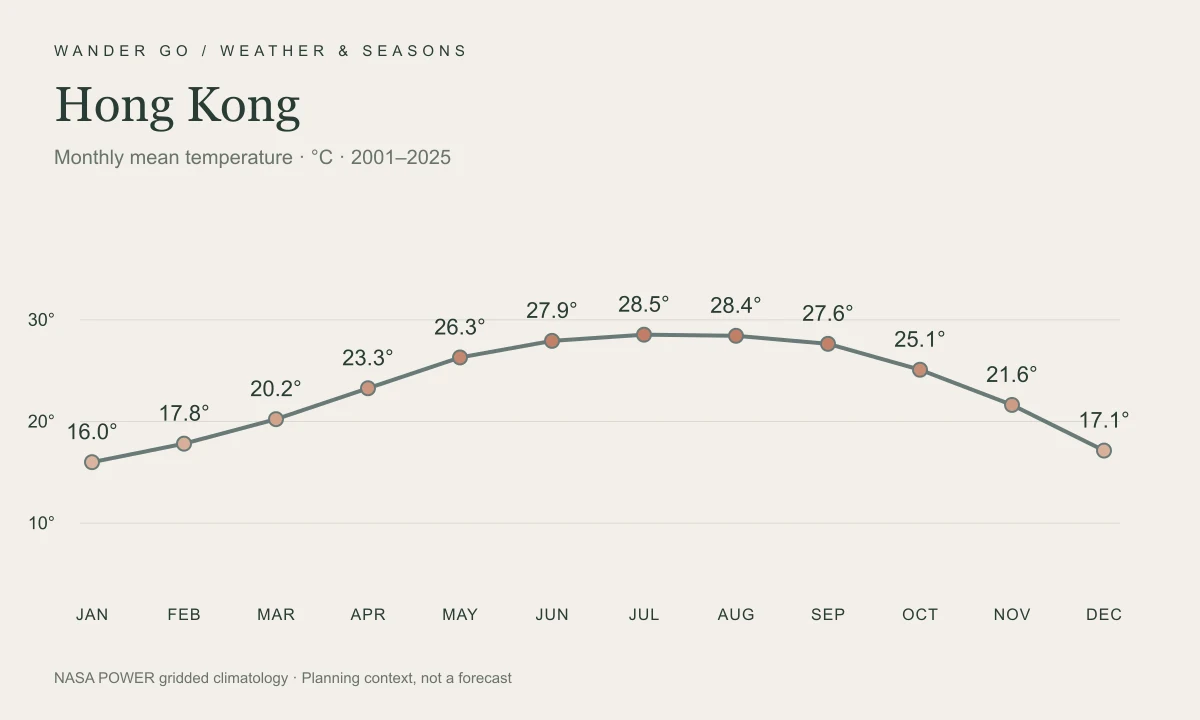
At the Hong Kong reference point, the December mean is 17.1 °C, compared with 21.6 °C in November. Estimated monthly precipitation is about 25 mm. These figures describe the long-term background; they do not predict the dates of your visit.
Scroll sideways to see all columns.
| Reference point | Month | Mean air temperature | Approx. monthly precipitation |
|---|---|---|---|
| Hong Kong | November | 21.6 °C | 30 mm |
| Hong Kong | December | 17.1 °C | 25 mm |
| Hong Kong | January | 16.0 °C | 36 mm |
December beyond the monthly average
December can suit neighbourhood walks and harbour views, but pack for changes within the day. The Hong Kong Observatory’s December overview notes that cold surges can bring colder, drier conditions. That is seasonal context, not a forecast for your dates.
Use the nine-day forecast as departure approaches, then check the day’s warnings. A calm street at lunchtime does not tell you how comfortable a long evening on an exposed promenade will feel. With children or older relatives, choose a nearby indoor break before everyone becomes tired or cold.
What to wear in each setting
Scroll sideways to see all columns.
| Setting | Useful clothing | Practical adjustment |
|---|---|---|
| Streets | Comfortable walking shoes, a light top and removable knit or fleece | Central’s slopes make short, grouped walks easier than a long checklist |
| Harbour | A wind-resistant outer layer over your usual layers | Keep it accessible for waterfront stops and the return after dark |
| Hills | A warmer layer and a light waterproof shell | Check visibility, wind and operating notices before going uphill |
| Indoors | A light cardigan or overshirt | Adapt to air-conditioned galleries, trains and restaurants |
Avoid carrying only a heavy coat that is awkward to remove. Keep dry socks available after wet walks, and choose shoes for steps and slopes rather than just photographs.
Three days with fewer crossings
This outline groups stops geographically. Swap whole days around the forecast and opening calendar; do not spend a wet afternoon repeatedly crossing the harbour to rescue a crowded itinerary.
Scroll sideways to see all columns.
| Day | Area and suggested order | Keep flexible |
|---|---|---|
| Day 1 | Hong Kong Island: Sheung Wan, Hollywood Road, Central; the Peak if conditions suit | Move the viewpoint to a clearer day; keep a café or gallery pause nearby |
| Day 2 | Kowloon: Tsim Sha Tsui, Museum of Art, Clock Tower and the waterfront | Shorten the promenade in wind or rain; add a neighbourhood walk only if energy allows |
| Day 3 | Lantau: Tung Chung, Ngong Ping and the Big Buddha area | Confirm cable-car service and your return plan before leaving the city |
The tourism board’s Old Town Central guide helps select a small area around heritage streets, shops and food. Its Tsim Sha Tsui promenade guide places the Clock Tower, cultural venues and harbourfront together.
For day three, leave enough time to return from the hills before any onward transport. Do not add a distant island, shopping stop and tightly timed airport departure to the same outing. Our Victoria Peak and Tian Tan Buddha guides can help you choose which outing matters most.
Rainy-day alternatives need an opening check
In Tsim Sha Tsui, the Hong Kong Museum of Art is a practical indoor anchor beside the waterfront. Its published schedule closes on Thursdays except public holidays, and lists shorter hours on Christmas Eve. Check your date and any special-exhibition arrangements before making it the day’s main plan.
M+ in West Kowloon publishes regular Tuesday–Sunday opening. Do not assume it is a Monday fallback: check the date-specific calendar and ticket arrangements first. West Kowloon is a separate stop, not the same building as the Museum of Art. Choose one museum with time to enjoy it rather than treating indoor places as interchangeable shelters.
If a weather warning makes travel unsuitable, an open museum is not a reason to ignore that warning. Follow local guidance and the venue’s own announcements.
Check mountain transport before setting off
Ngong Ping 360’s FAQ explains that scheduled servicing can stop the cable car while the village stays open, and adverse weather can also interrupt service. Confirm the outward and return arrangements; an online ticket alone does not establish that a ride is operating.
The Peak operator’s weather arrangements distinguish the tram, tower and viewing terrace. Their service conditions are not identical, so check the actual facility you intend to use.
Hong Kong and mainland travel documents
Check each part of a Hong Kong–mainland journey separately. Start with the Hong Kong Immigration Department and use the category matching your nationality or resident status; consult the National Immigration Administration for the mainland leg. Admission to one place should not be treated as confirmation of admission to the other. We do not infer eligibility, permitted stay or required documents from this itinerary.
Ask our planner to organise your preferred dates, walking pace and arrival or departure point. Only a contact method is required; other details help us plan the route. Source check: 22 November 2026.
Compare other months: January · February · March · April · May · June · July · August · September · October · November.
How to read these figures
Data: NASA POWER meteorological climatology, January 2001–December 2025. Temperatures here are monthly mean air temperatures at two metres, not daytime highs or overnight lows. Approximate monthly precipitation is the supplied mean daily rate multiplied by the average calendar length of that month over the same 25 years, rounded to the nearest millimetre. This is a gridded model reference, not a local weather-station observation or a live forecast. Coastal, valley and mountain conditions may differ from a sampled grid. Check a current local forecast and any site or transport announcements before setting out.
Reference coordinates: Hong Kong 22.319° N, 114.169° E.