Start with nights in China, then choose the route
For a first trip, our starting point is 10–14 days when you want several contrasting destinations. Seven days can work well for one region or two connected cities. Three weeks allows a broader journey with recovery time. These are planning suggestions, not a minimum required to enjoy China: the right duration depends on flights, interests and how often you want to move hotels.
Count from the day you land in China to the day you leave. A seven-day trip with arrival on day 1 and departure on day 7 usually means six hotel nights, not seven full sightseeing days. An overnight international flight may also use a day of your annual leave without adding a day in China. Write the arrival and departure times beside the dates before comparing itineraries.
Compare 7, 10, 14 and 21 days
The following examples assume arrival in the first city and departure from the last. Nights are deliberate starting allocations; they can be moved when flights, reservations or your priorities make another sequence better.
Scroll sideways to see all columns.
| Time in China | Example route and hotel nights | Intercity moving days | What you gain and give up |
|---|---|---|---|
| 7 days / 6 nights | Beijing 4 + Xi’an 2 | 1 | Two strong historical contrasts; little room for another region |
| 10 days / 9 nights | Beijing 3 + Xi’an 3 + Shanghai 3 | 2 | Imperial, archaeological and contemporary China; limited spare time in Beijing |
| 14 days / 13 nights | Beijing 4 + Xi’an 3 + Chengdu 3 + Shanghai 3 | 3 | Adds pandas and Sichuan daily life; still requires choices about day trips |
| 21 days / 20 nights | Beijing 5 + Xi’an 3 + Chengdu 4 + Zhangjiajie 4 + Shanghai 4 | 4 | Adds mountain scenery and slower blocks; more hotel and transport logistics |
“Moving day” means a day with an intercity transfer, not a promise that it takes the whole day or that the remaining hours are usable for a major attraction. The Zhangjiajie block may use two hotels, so five destination areas can mean six hotel bases. These are examples to compare, rather than a recommendation to book every connection before checking the timetable.
Seven days: keep the strongest contrast
Choose Beijing and Xi’an if the Great Wall, the Palace Museum and the Terracotta Warriors are your main reasons for coming. Four nights in Beijing leave three days between arrival and the move to Xi’an. Two nights in Xi’an allow one clear sightseeing day; make the Terracotta Warriors the priority and treat city-wall time as dependent on the connections. Arriving late or leaving early makes this distinction especially important.
Alternatively, stay in Shanghai with one nearby overnight stop, or make Chengdu your main base with a focused excursion. One region can be a richer holiday than spending the week checking into new hotels. Our Beijing five-day plan, Shanghai five-day plan and Chengdu five-day plan show what a single base can hold; extra nights can slow these plans down.
Ten days: three cities, or two at a gentler pace
The Beijing–Xi’an–Shanghai ten-day route provides a useful first-visit comparison. With three nights in Beijing, the two full days can cover the palace and a separate Great Wall outing. Xi’an has room for the Terracotta Warriors and a city day. Shanghai provides a different scale, architecture and rhythm before departure. A closed-day or ticket conflict may require moving nights between cities.
For a gentler version, divide nine nights between Beijing and Shanghai and use one regional excursion. Keep the same international trip length while removing a transfer, packing session and hotel check-in. For a different emphasis, our Chengdu, Chongqing and Zhangjiajie ten-day route prioritises Sichuan life, river cities and mountains; it should replace the classic route, not be squeezed into its free evenings.
Fourteen days: add one experience that changes the journey
Four extra days do not have to mean four extra cities. In the sample route, an additional Beijing night helps with the palace, wall and a less structured city day. Chengdu adds a panda visit, tea-house time and a different food culture. Three Chengdu nights normally provide two full days between the moving days, so a long excursion competes with city time rather than arriving as a free extra.
If dramatic scenery matters more than pandas, replace Chengdu with a properly paced mountain or countryside block. Read the Zhangjiajie five-day plan before cutting it down to a single day: forest-park areas and Tianmen Mountain are separate visits. Compare the actual onward connection before assuming the replacement has the same travel burden. With four bases, another famous stop can be the point at which the holiday becomes mostly logistics.
A fourteen-day example: Beijing, Xi’an, Chengdu and Shanghai
This planning example uses the four-base, thirteen-night allocation above. It assumes arrival in Beijing on day 1 and departure from Shanghai on day 14. There are three moving days, on days 5, 8 and 11; the actual train or flight must be chosen for your date before the sequence is confirmed. It is an outline to adapt, not a reserved package or a claim that all connections are direct.
Scroll sideways to see all columns.
| Day | Suggested focus and pace | Overnight |
|---|---|---|
| 1 | Arrive in Beijing, reach the hotel and keep the evening local. | Beijing |
| 2 | Give the Palace Museum the main part of the day; keep later plans flexible. | Beijing |
| 3 | Take a separate Great Wall excursion, choosing the section and walking effort together. | Beijing |
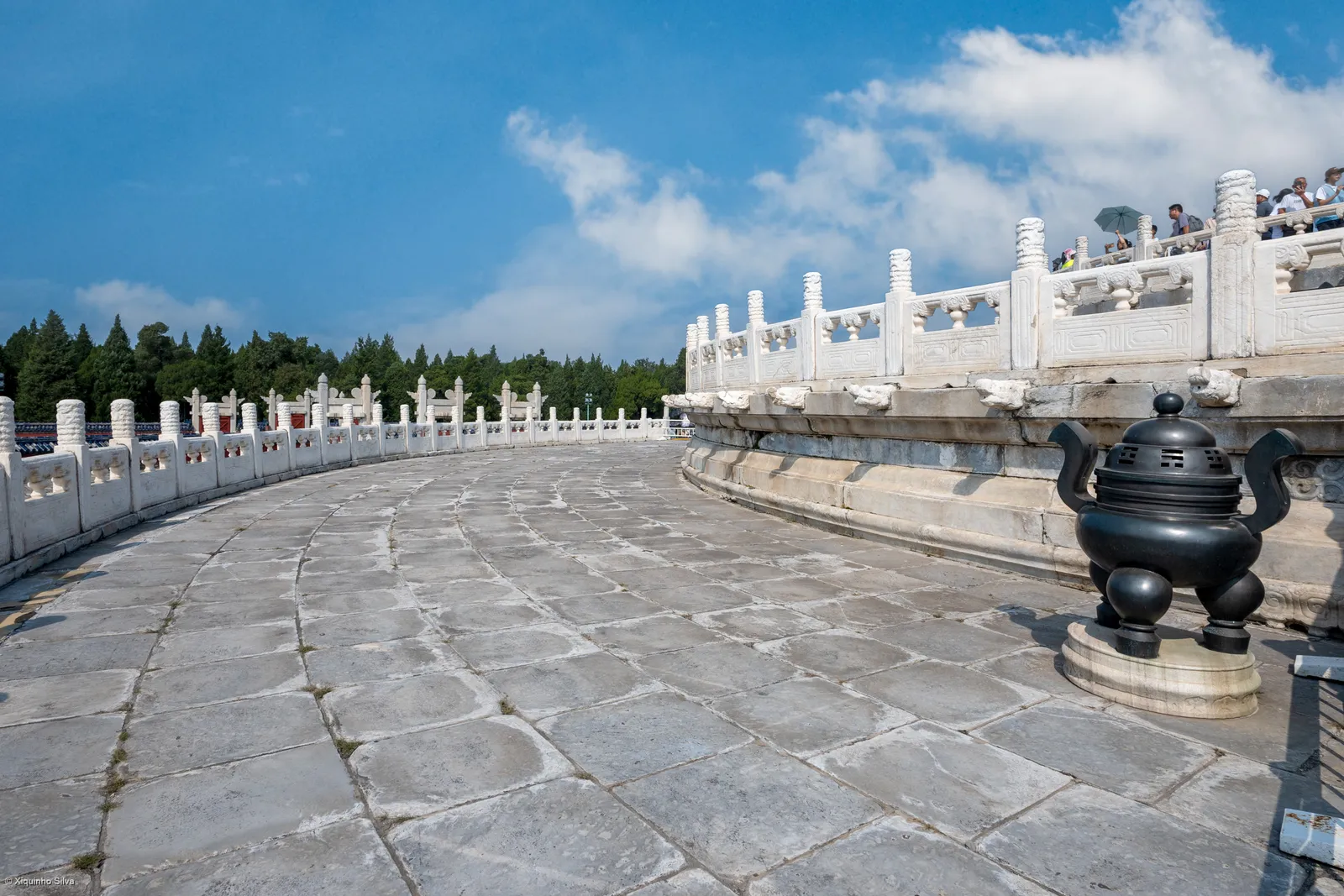
| 4 | Visit the Temple of Heaven or spend an easier day in neighbourhood lanes; leave time for a proper meal. | Beijing |
| 5 | Move to Xi’an. After check-in, take a short local walk only if arrival time and energy allow. | Xi’an |
| 6 | Make the Terracotta Warriors the priority rather than adding another distant excursion. | Xi’an |
| 7 | Combine a manageable part of the City Wall with old-city streets and food; adjust for heat or tired legs. | Xi’an |
| 8 | Travel to Chengdu and settle in. Keep a booked dinner or activity away from a tight arrival. | Chengdu |
| 9 | Plan a panda visit, followed by a quieter afternoon instead of another major outing. | Chengdu |
| 10 | Choose tea-house time, a neighbourhood walk and Sichuan food; a longer excursion would replace this city day. | Chengdu |
| 11 | Move to Shanghai; reach the hotel before deciding whether an evening riverside walk is comfortable. | Shanghai |
| 12 | Explore the Bund and a chosen nearby area, with breaks rather than a race between skyline viewpoints. | Shanghai |
| 13 | Choose Yu Garden and old-city streets, or a museum and neighbourhood day according to interests and reservations. | Shanghai |
| 14 | Depart from Shanghai, with a transfer planned around the actual flight. | Departure |
For hotels, compare central Dongcheng or Xicheng in Beijing, an old-city base in Xi’an, the Tianfu Square or Wenshu area in Chengdu, and Huangpu or Jing’an in Shanghai. These are areas to investigate, not claims that any specific hotel is available or within walking distance of every visit. Check the exact address, room type, stairs or access needs, and the drive to the station or airport before choosing.
The night count is Beijing 4, Xi’an 3, Chengdu 3 and Shanghai 3. Use the actual number of rooms and nights when requesting a quote; the cost guide explains how to compare inclusions. Dates, admissions and transport remain to be confirmed. Move the palace day if the booking calendar requires it, and keep an indoor or lighter alternative for outdoor days. If your flights use the same arrival and departure city, the return leg must be added or another stop removed.
Twenty-one days: spend some of the extra time staying still
The example uses twenty nights across five destination areas. Five Beijing nights give room to adjust the palace day and enjoy a quieter neighbourhood day. Four nights in Chengdu can include a chosen excursion. Four in Zhangjiajie provide room for forest-park days, Tianmen and a change of hotel when useful. Four Shanghai nights allow museums and neighbourhoods without making every morning an early start.
Keep one lighter block after several demanding days, and choose a later start when the transport allows. The Chengdu–Zhangjiajie and Zhangjiajie–Shanghai connections need a date-specific rail or air comparison; this outline does not assume a direct service. If a connection is awkward, change the sequence or drop a destination. Do not sacrifice every rest period to preserve a line on a map. Our slow-travel ideas can help decide where an extra night is more valuable than another stop.
Count the time that a transfer actually uses
A departure time on a ticket is only one part of the move. Include packing, checkout, the trip to the correct station or airport, entry checks, the journey, luggage collection where applicable and the transfer to the new hotel. Compare rail and air door to door, using the official China Railway service for current trains rather than carrying a timetable from another season into your plan. Our China train-booking guide explains the preparation.
Arrival and departure days deserve the same treatment. An early arrival does not guarantee an immediately available hotel room. A late flight does not make a distant mountain outing a sensible final activity. Keep essential visits away from the final connection and leave a practical departure buffer.
Choose a transfer that suits the people travelling
For each move between cities, compare two real options for the same travel date and hotel locations. A shorter flight does not automatically create more sightseeing time; a convenient train can still be a poor choice if its arrival station is far from your hotel. Record the full station name or airport and terminal before comparing prices.
Scroll sideways to see all columns.
| Your travel priority | What to compare | When to simplify the route |
|---|---|---|
| A first visit | Hotel departure to arrival at the next hotel, plus the usable time on each side | Remove a base if moving leaves too little time for the experience you came for. |
| Families or groups | Boarding changes, luggage handling, seats together and the help available | Prefer a simpler journey over a small saving in the timetable. |
| Less walking | Step-free access, terminal or station walking and assistance that can actually be booked | Keep another night in one place if the transfer would leave no recovery time. |
| Rural scenery | The station or airport followed by the actual transfer to your overnight base | Change the order or omit a stop if the connection only works with a rushed arrival. |
Make a short comparison sheet for each option: hotel-to-departure-point travel; the carrier's required check-in or boarding margin; scheduled journey; any interchange; arrival procedures and luggage; and travel to the next hotel. Mark the timetable portion as scheduled and the road, waiting and hotel portions as estimated. The sum is a planning estimate, not a guaranteed journey time.
China Railway's boarding guidance directs passengers to station notices for ticket-check closing times. For air connections, check the specific airline's rules; Shanghai Airport's transfer guidance also tells passengers to confirm connection and baggage requirements with the airline. A train ride between airports is only one part of changing airports.
Sources checked on 22 November 2026. This comparison does not confirm a direct service, seats or flight connection for your date. See our train booking guide, or include your arrival and departure plans in a custom trip enquiry.
Questions that change the answer
Is one week too short?
No, if the scope fits the time. Choose one region or a compact two-city route and accept what you are leaving for another visit. A week is short for a national highlights circuit, especially after long-haul flights.
Should families or older travellers add days?
Add room for breaks before adding destinations. Walking tolerance, stairs, meal routines and the time needed to repack can matter more than age alone. A longer stay in one hotel may help more than upgrading a tightly timed transfer. Use our family-travel guide to frame those preferences.
Does a visa-free allowance decide the trip length?
It sets a possible entry condition, not a sightseeing plan. Eligibility, permitted stay and any routing restrictions must be checked for your own passport and journey through the National Immigration Administration or the relevant Chinese consulate. Do not treat a sample itinerary on this page as confirmation that a particular entry policy applies to you.
Turn the duration into your own trip
Compare the hotel, transport, guiding and admission scope with our China trip cost guide.
Send your available dates, arrival and departure cities if known, two or three must-see interests and your preferred pace through Custom. Contact information is the only required form field. Our travel designer will follow up to discuss the route; submitting the form does not reserve transport or produce a confirmed price. For a wider preparation checklist, continue with planning your first China trip.