Climate reference
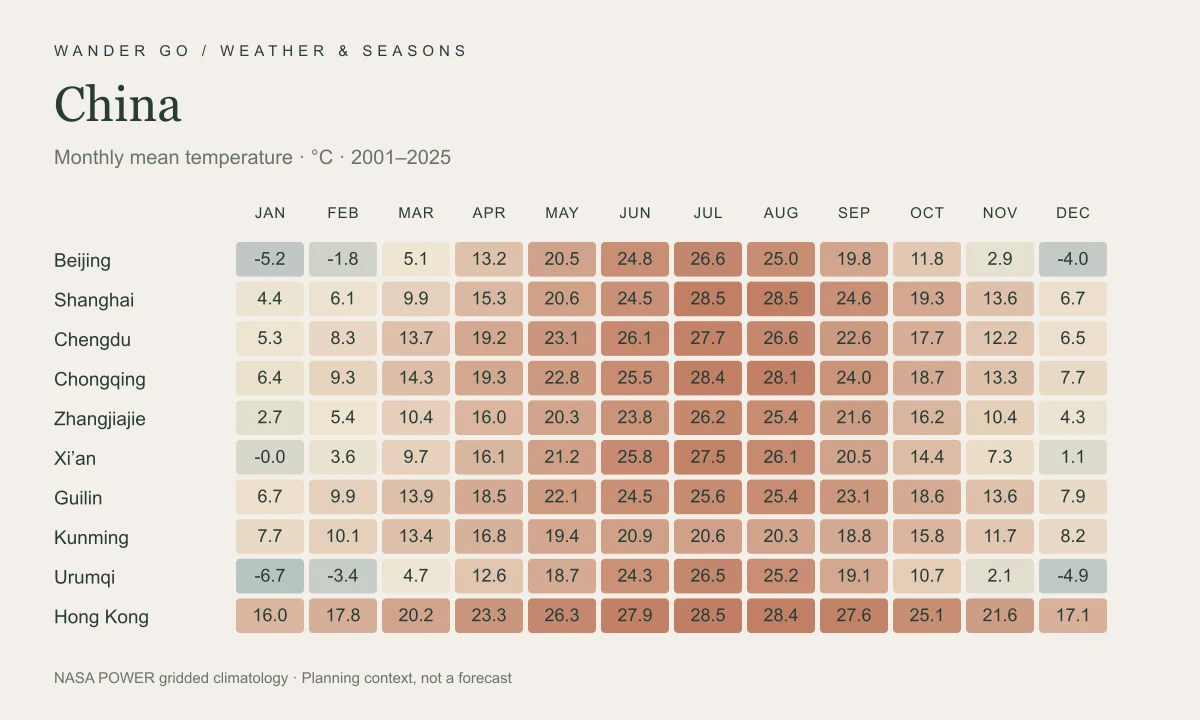
At the Beijing reference point, the January mean is -5.2 °C, compared with -4.0 °C in December. Estimated monthly precipitation is about 2 mm. These figures describe the long-term background; they do not predict the dates of your visit. Among the selected reference points, the monthly means range from -6.7 °C at Urumqi to 16.0 °C at Hong Kong. Use the point nearest your actual overnight stop rather than treating the whole region as one temperature.
Scroll sideways to see all columns.
| Reference point | Month | Mean air temperature | Approx. monthly precipitation |
|---|---|---|---|
| Beijing | December | -4.0 °C | 2 mm |
| Beijing | January | -5.2 °C | 2 mm |
| Beijing | February | -1.8 °C | 6 mm |
| Shanghai | December | 6.7 °C | 53 mm |
| Shanghai | January | 4.4 °C | 67 mm |
| Shanghai | February | 6.1 °C | 78 mm |
| Chengdu | December | 6.5 °C | 11 mm |
| Chengdu | January | 5.3 °C | 12 mm |
| Chengdu | February | 8.3 °C | 14 mm |
| Chongqing | December | 7.7 °C | 21 mm |
| Chongqing | January | 6.4 °C | 22 mm |
| Chongqing | February | 9.3 °C | 21 mm |
| Zhangjiajie | December | 4.3 °C | 32 mm |
| Zhangjiajie | January | 2.7 °C | 42 mm |
| Zhangjiajie | February | 5.4 °C | 59 mm |
| Xi’an | December | 1.1 °C | 6 mm |
| Xi’an | January | -0.0 °C | 9 mm |
| Xi’an | February | 3.6 °C | 13 mm |
| Guilin | December | 7.9 °C | 54 mm |
| Guilin | January | 6.7 °C | 66 mm |
| Guilin | February | 9.9 °C | 68 mm |
| Kunming | December | 8.2 °C | 12 mm |
| Kunming | January | 7.7 °C | 20 mm |
| Kunming | February | 10.1 °C | 8 mm |
| Urumqi | December | -4.9 °C | 15 mm |
| Urumqi | January | -6.7 °C | 10 mm |
| Urumqi | February | -3.4 °C | 13 mm |
| Hong Kong | December | 17.1 °C | 25 mm |
| Hong Kong | January | 16.0 °C | 36 mm |
| Hong Kong | February | 17.8 °C | 29 mm |
Packing and the daily rhythm
The monthly mean is below freezing. Build the outdoor day in short sections with warm indoor breaks, and choose footwear after checking local ground conditions. The monthly mean is not a forecast of the warmest hour, so a sunny photograph is not a reliable packing guide. The precipitation background is relatively dry. Still check wind, visibility and short-term warnings before a longer exposed excursion; a low monthly total does not establish clear skies. If your dates overlap Lunar New Year, check that year’s holiday calendar and reservations separately; the climate table says nothing about opening days or availability.
Shape the journey around the place
Beijing. Long open courtyards and an exposed Great Wall day need different pacing from museum visits. Keep the wall day movable within a stay of several nights.
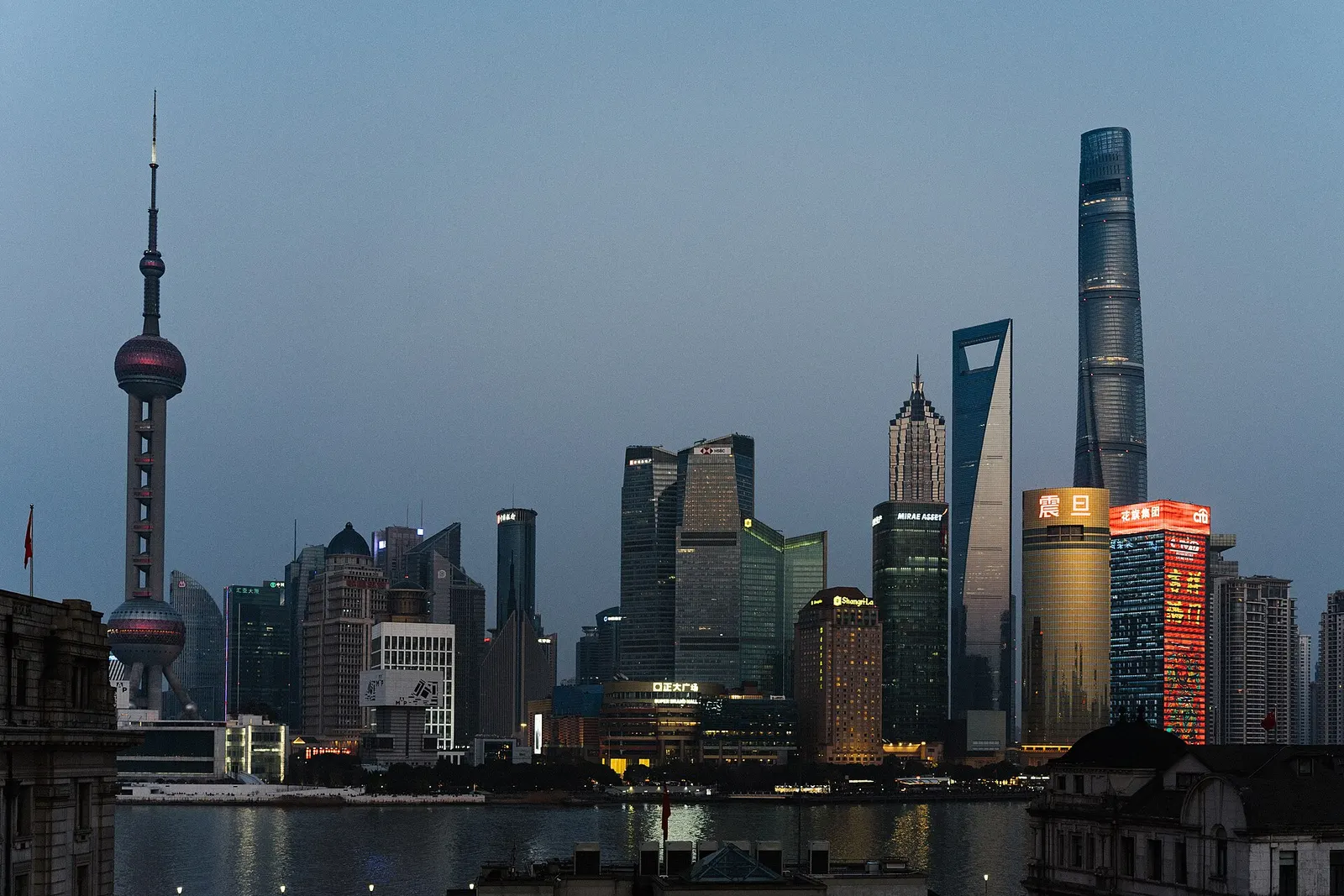
Shanghai. Give the Bund a flexible walking window rather than a guaranteed skyline view. Pair it with neighbourhood interiors or a museum; water-town day trips need their own local check.
Chengdu. Separate a panda-base visit from excursions into western Sichuan. The basin reference is useful for the city, while mountain overnights need their own forecasts and clothing plan.
Chongqing. Walking distances in the central city include stairs and slopes. Choose one neighbourhood for a long walk, then allow a proper rest; Wulong needs a separate mountain-day decision.
Zhangjiajie. Leave more than one possible viewing window for mountain scenery. Low cloud changes visibility, and a city grid cannot determine cableway operation or conditions on high walkways.
Xi’an. Separate the archaeological excursion from a long city-wall walk. Use museums and old-town meals to vary the day, then confirm conditions for any mountain extension independently.
Guilin. Leave room to change the order of river scenery and indoor visits. A Li River outing depends on the actual operator and water conditions, not simply a monthly rainfall average.
Kunming. Leave time to settle in before a full sightseeing day, and keep a covered option alongside city parks. Continuing to tropical southern Yunnan or higher northern towns changes the packing needs.
Urumqi. Use the city as a starting point, then check lake, mountain and desert stops separately. The weather near a city hotel cannot confirm a road's opening or a distant scenic area's operation.
Hong Kong. Separate urban walks from exposed trails and boat outings. The Hong Kong Observatory's current warnings matter for those activities even when monthly averages look comfortable.
Compare other months: February · March · April · May · June · July · August · September · October · November · December.
How to read these figures
Data: NASA POWER meteorological climatology, January 2001–December 2025. Temperatures here are monthly mean air temperatures at two metres, not daytime highs or overnight lows. Approximate monthly precipitation is the supplied mean daily rate multiplied by the average calendar length of that month over the same 25 years, rounded to the nearest millimetre. This is a gridded model reference, not a local weather-station observation or a live forecast. Coastal, valley and mountain conditions may differ from a sampled grid. Check a current local forecast and any site or transport announcements before setting out.
Reference coordinates: Beijing 39.904° N, 116.407° E; Shanghai 31.230° N, 121.474° E; Chengdu 30.572° N, 104.066° E; Chongqing 29.564° N, 106.551° E; Zhangjiajie 29.117° N, 110.479° E; Xi’an 34.341° N, 108.940° E; Guilin 25.273° N, 110.290° E; Kunming 25.038° N, 102.718° E; Urumqi 43.825° N, 87.617° E; Hong Kong 22.319° N, 114.169° E.