Climate reference
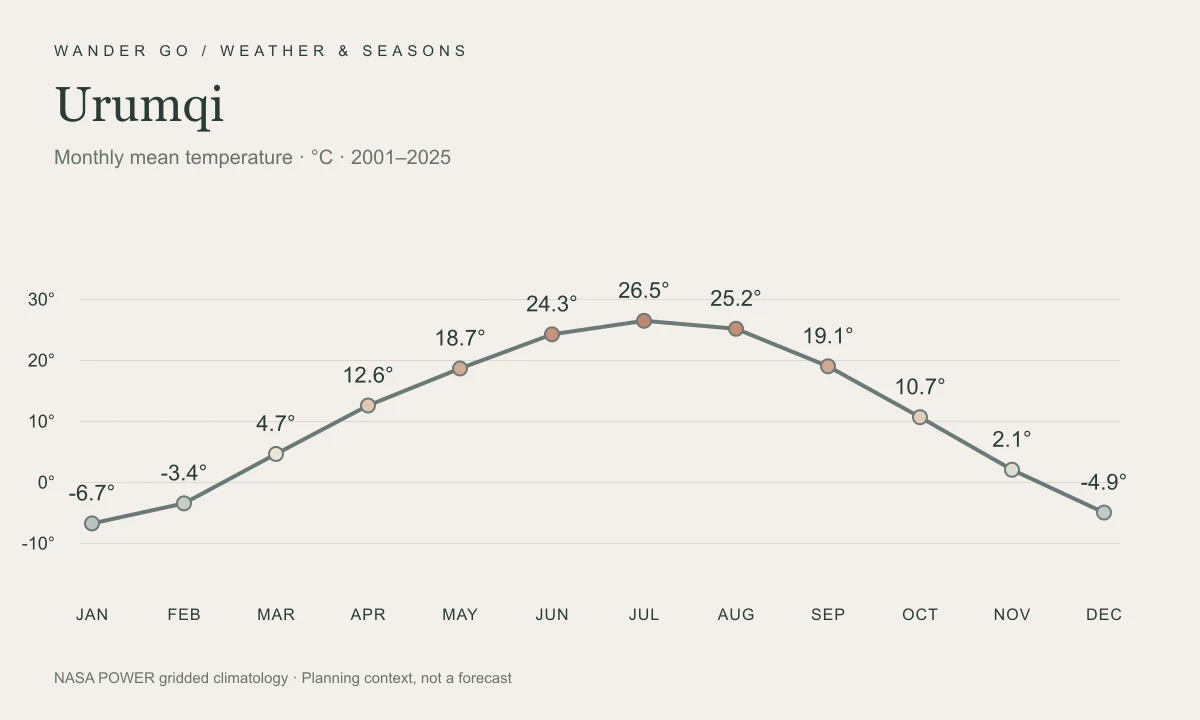
At the Urumqi reference point, the March mean is 4.7 °C, compared with -3.4 °C in February. Estimated monthly precipitation is about 14 mm. These figures describe the long-term background; they do not predict the dates of your visit.
Scroll sideways to see all columns.
| Reference point | Month | Mean air temperature | Approx. monthly precipitation |
|---|---|---|---|
| Urumqi | February | -3.4 °C | 13 mm |
| Urumqi | March | 4.7 °C | 14 mm |
| Urumqi | April | 12.6 °C | 35 mm |
Packing and the daily rhythm
Cool conditions make adaptable layers useful. Keep a warmer layer available for a slower outdoor stop, and avoid building a day that depends on standing outside for hours. Check the actual daytime and overnight forecast before deciding how much insulation to bring. The precipitation background is relatively dry. Still check wind, visibility and short-term warnings before a longer exposed excursion; a low monthly total does not establish clear skies.
Shape the journey around the place
Urumqi. Use the city as a starting point, then check lake, mountain and desert stops separately. The weather near a city hotel cannot confirm a road's opening or a distant scenic area's operation.
Compare other months: January · February · April · May · June · July · August · September · October · December.
How to read these figures
Data: NASA POWER meteorological climatology, January 2001–December 2025. Temperatures here are monthly mean air temperatures at two metres, not daytime highs or overnight lows. Approximate monthly precipitation is the supplied mean daily rate multiplied by the average calendar length of that month over the same 25 years, rounded to the nearest millimetre. This is a gridded model reference, not a local weather-station observation or a live forecast. Coastal, valley and mountain conditions may differ from a sampled grid. Check a current local forecast and any site or transport announcements before setting out.
Reference coordinates: Urumqi 43.825° N, 87.617° E.