When is the best time to visit China?
For a first journey combining several major cities, compare April–May and September–October as starting windows, then refine the choice around the places you most want to see. This is an editorial planning suggestion based on the historical city reference points below: there is no single best month for the whole country. A winter city break, a mountain-view holiday and a family trip tied to school dates need different answers.
Start with the experience, then the region, then the month. If the Great Wall, old neighbourhoods and long outdoor walks matter most, compare comfortable walking conditions. If your main interests are museums, food and a slower urban stay, you can build more of the day around interiors. If mountain views are essential, allow more than one possible viewing window instead of relying on a single forecast far in advance.
Compare the four travel seasons
Scroll sideways to see all columns.
| Window | A useful starting plan | What to allow for |
|---|---|---|
| March–May | City culture, gardens and flexible walking days | Regions warm at different rates; keep a rain option |
| June–August | A slower route that fits summer availability | Heat and rain in many city references; plan breaks |
| September–November | Compare city walks, food and cultural routes | Early and late autumn differ; check holiday dates |
| December–February | Museums, neighbourhood meals or a deliberate winter trip | Cold northern stops; separate snow activities from city plans |
The windows are broad seasonal groupings, not forecasts or promises of blossoms, snow or autumn colour. Look at the relevant destination and month before treating any one of them as your own travel season.
Choose a region, not a national average
For Beijing and Xi’an, compare the amount of outdoor walking with your tolerance for heat and cold. A wall walk and a museum visit place different demands on the day. In Shanghai, mix riverside and neighbourhood walks with indoor stops, leaving the long outdoor section movable.
For Chengdu and Chongqing, the urban reference points help compare city months; they cannot describe a mountain extension. In Guilin and Zhangjiajie, keep flexibility around the river or mountain experience that matters most to you. A cloudier day may still suit a village or food visit, but it cannot deliver a promised distant view.
For Yunnan, compare the actual overnight stops rather than applying Kunming’s figures to every altitude. For Xinjiang, choose the cultural or landscape route first. A Kashgar-focused journey and a northern mountain loop need separate local checks; Urumqi’s chart is not a substitute for either.
Hong Kong offers another useful comparison. The Hong Kong Observatory’s climate overview describes relatively comfortable November–December conditions and a hotter, more humid summer. Its climate guidance also explains the tropical-cyclone season. Use current warnings for a specific trail, ferry or excursion; the historical averages below do not establish whether a service will operate.
If your dates are fixed
Build the itinerary around the time you actually have. In a hotter window, reduce the length of exposed walking and put a proper break between major stops. In colder conditions, shorten long outdoor stretches and choose accommodation that makes returning for a rest practical. For a trip centred on scenery, keep an alternative activity and avoid putting every important viewpoint into one short afternoon.
Compare the official public-holiday calendar for the year of travel before finalising transfers and reservations. Do not assume that an attractive weather month is quiet, inexpensive or easy to book. A school-holiday family trip can still work well with fewer bases and enough time at each one; our family travel guide helps frame those choices.
Climate, forecast and operating notice are different tools
The NASA POWER climatology documentation explains the historical data service behind this page. The archived reference used here covers 2001–2025. It helps compare months; it does not predict the weather on your departure date. The method, units and coordinates are retained below so you can understand what each number represents.
Use three checks at different times: historical climate when choosing a season, a local forecast as the trip approaches, and the attraction or transport operator’s notices for the day itself. A city’s monthly mean temperature is neither its afternoon maximum nor the temperature on a mountain walkway. A monthly rainfall total does not tell you which hours will be wet.
Official references and the editorial guidance were reviewed on 20 November 2026. The following climate tables are historical reference data, not a newly issued forecast.
Climate reference
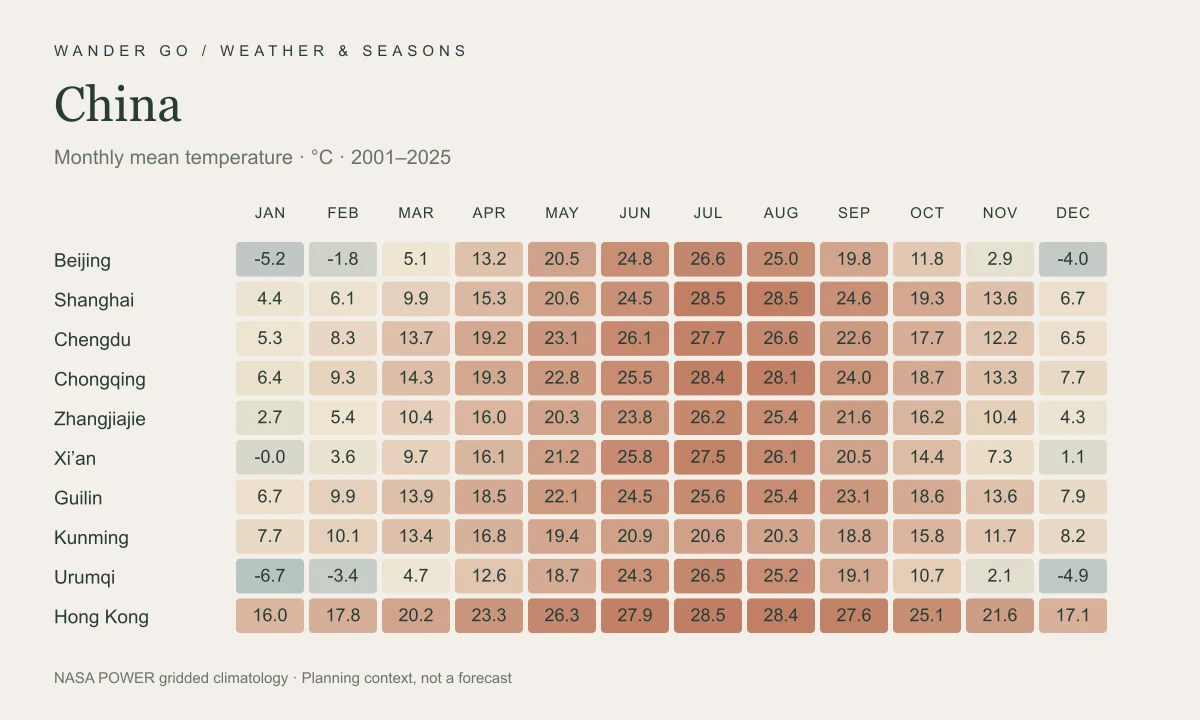
At the Beijing reference point, the warmest monthly mean is 26.6 °C in July, and the coolest is -5.2 °C in January. The largest estimated monthly precipitation total is about 151 mm in July. The warmest month is not automatically the best month for your preferred activities.
Scroll sideways to see all columns.
| Month | Mean air temperature | Approx. monthly precipitation |
|---|---|---|
| January | -5.2 °C | 2 mm |
| February | -1.8 °C | 6 mm |
| March | 5.1 °C | 9 mm |
| April | 13.2 °C | 24 mm |
| May | 20.5 °C | 38 mm |
| June | 24.8 °C | 84 mm |
| July | 26.6 °C | 151 mm |
| August | 25.0 °C | 108 mm |
| September | 19.8 °C | 64 mm |
| October | 11.8 °C | 30 mm |
| November | 2.9 °C | 14 mm |
| December | -4.0 °C | 2 mm |
Scroll sideways to see all columns.
| Other reference points | January mean | July mean |
|---|---|---|
| Shanghai | 4.4 °C | 28.5 °C |
| Chengdu | 5.3 °C | 27.7 °C |
| Chongqing | 6.4 °C | 28.4 °C |
| Zhangjiajie | 2.7 °C | 26.2 °C |
| Xi’an | -0.0 °C | 27.5 °C |
| Guilin | 6.7 °C | 25.6 °C |
| Kunming | 7.7 °C | 20.6 °C |
| Urumqi | -6.7 °C | 26.5 °C |
| Hong Kong | 16.0 °C | 28.5 °C |
Packing and the daily rhythm
Choose a travel window by the experience you want: sustained outdoor walking, a slower city stay, or a multi-stop journey. Compare the relevant months in the table, then pack for the actual daytime and overnight forecast. For a route with different landscapes, keep clothing adaptable and plan an indoor or sheltered option at the main outdoor stops.
Shape the journey around the place
Beijing. Long open courtyards and an exposed Great Wall day need different pacing from museum visits. Keep the wall day movable within a stay of several nights.
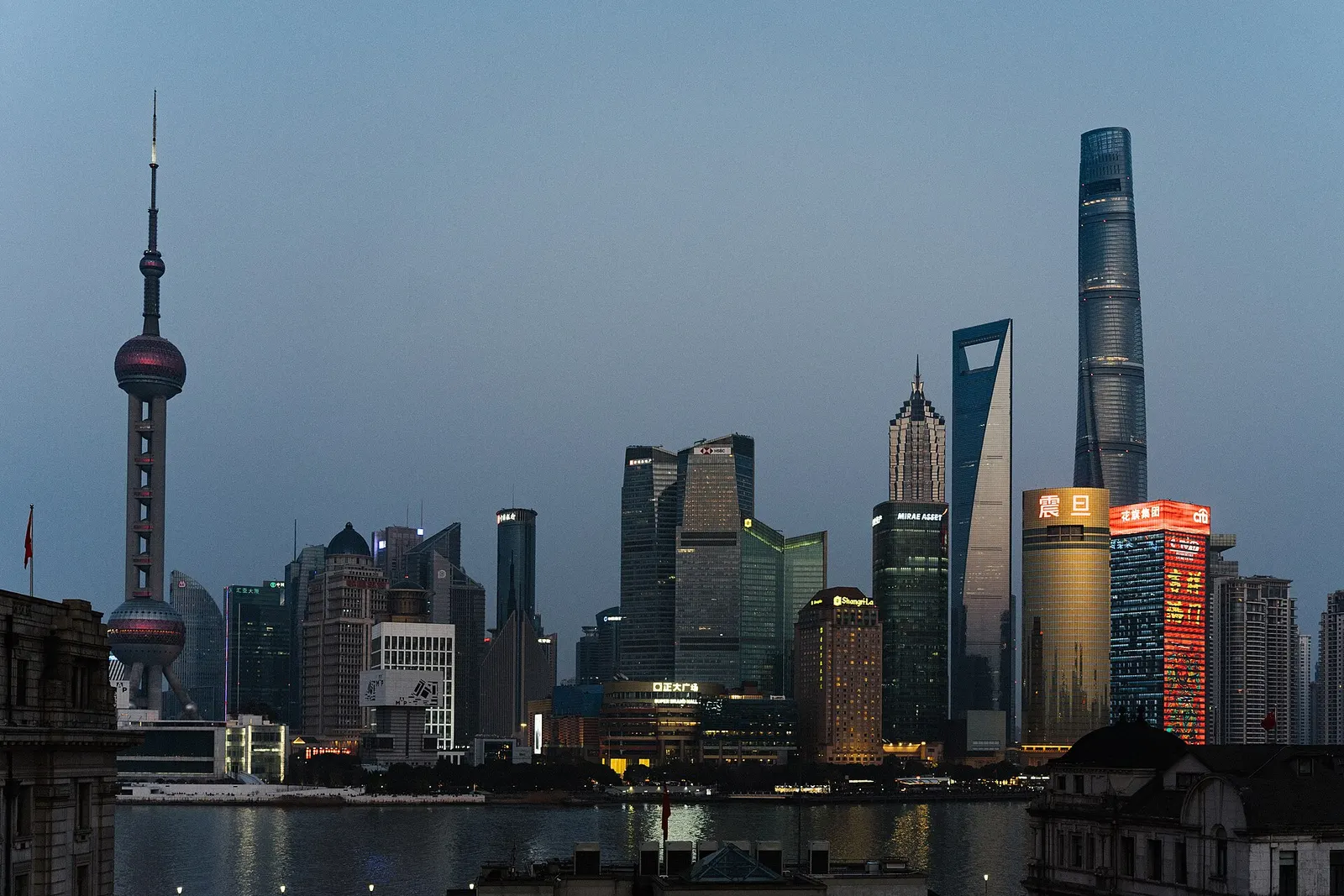
Shanghai. Give the Bund a flexible walking window rather than a guaranteed skyline view. Pair it with neighbourhood interiors or a museum; water-town day trips need their own local check.
Chengdu. Separate a panda-base visit from excursions into western Sichuan. The basin reference is useful for the city, while mountain overnights need their own forecasts and clothing plan.
Chongqing. Walking distances in the central city include stairs and slopes. Choose one neighbourhood for a long walk, then allow a proper rest; Wulong needs a separate mountain-day decision.
Zhangjiajie. Leave more than one possible viewing window for mountain scenery. Low cloud changes visibility, and a city grid cannot determine cableway operation or conditions on high walkways.
Xi’an. Separate the archaeological excursion from a long city-wall walk. Use museums and old-town meals to vary the day, then confirm conditions for any mountain extension independently.
Guilin. Leave room to change the order of river scenery and indoor visits. A Li River outing depends on the actual operator and water conditions, not simply a monthly rainfall average.
Kunming. Leave time to settle in before a full sightseeing day, and keep a covered option alongside city parks. Continuing to tropical southern Yunnan or higher northern towns changes the packing needs.
Urumqi. Use the city as a starting point, then check lake, mountain and desert stops separately. The weather near a city hotel cannot confirm a road's opening or a distant scenic area's operation.
Hong Kong. Separate urban walks from exposed trails and boat outings. The Hong Kong Observatory's current warnings matter for those activities even when monthly averages look comfortable.
Compare other months: January · February · March · April · May · June · July · August · September · October · November · December.
How to read these figures
Data: NASA POWER meteorological climatology, January 2001–December 2025. Temperatures here are monthly mean air temperatures at two metres, not daytime highs or overnight lows. Approximate monthly precipitation is the supplied mean daily rate multiplied by the average calendar length of that month over the same 25 years, rounded to the nearest millimetre. This is a gridded model reference, not a local weather-station observation or a live forecast. Coastal, valley and mountain conditions may differ from a sampled grid. Check a current local forecast and any site or transport announcements before setting out.
Reference coordinates: Beijing 39.904° N, 116.407° E; Shanghai 31.230° N, 121.474° E; Chengdu 30.572° N, 104.066° E; Chongqing 29.564° N, 106.551° E; Zhangjiajie 29.117° N, 110.479° E; Xi’an 34.341° N, 108.940° E; Guilin 25.273° N, 110.290° E; Kunming 25.038° N, 102.718° E; Urumqi 43.825° N, 87.617° E; Hong Kong 22.319° N, 114.169° E.
Match the season to the length of the trip
Once you have a travel window, compare our first China trip guide and 10-, 14- and 21-day planning options. Leave room for transfers and a change of activity rather than adding a new city simply to fill each day. The China trip cost guide helps separate the services you want from the headline price.
If you would like help balancing places and dates, send your plans through Custom. Contact information is the only required field. Tell us whether your dates are fixed and which experiences matter most; a travel designer will follow up with a suitable direction for the journey.